Loading...
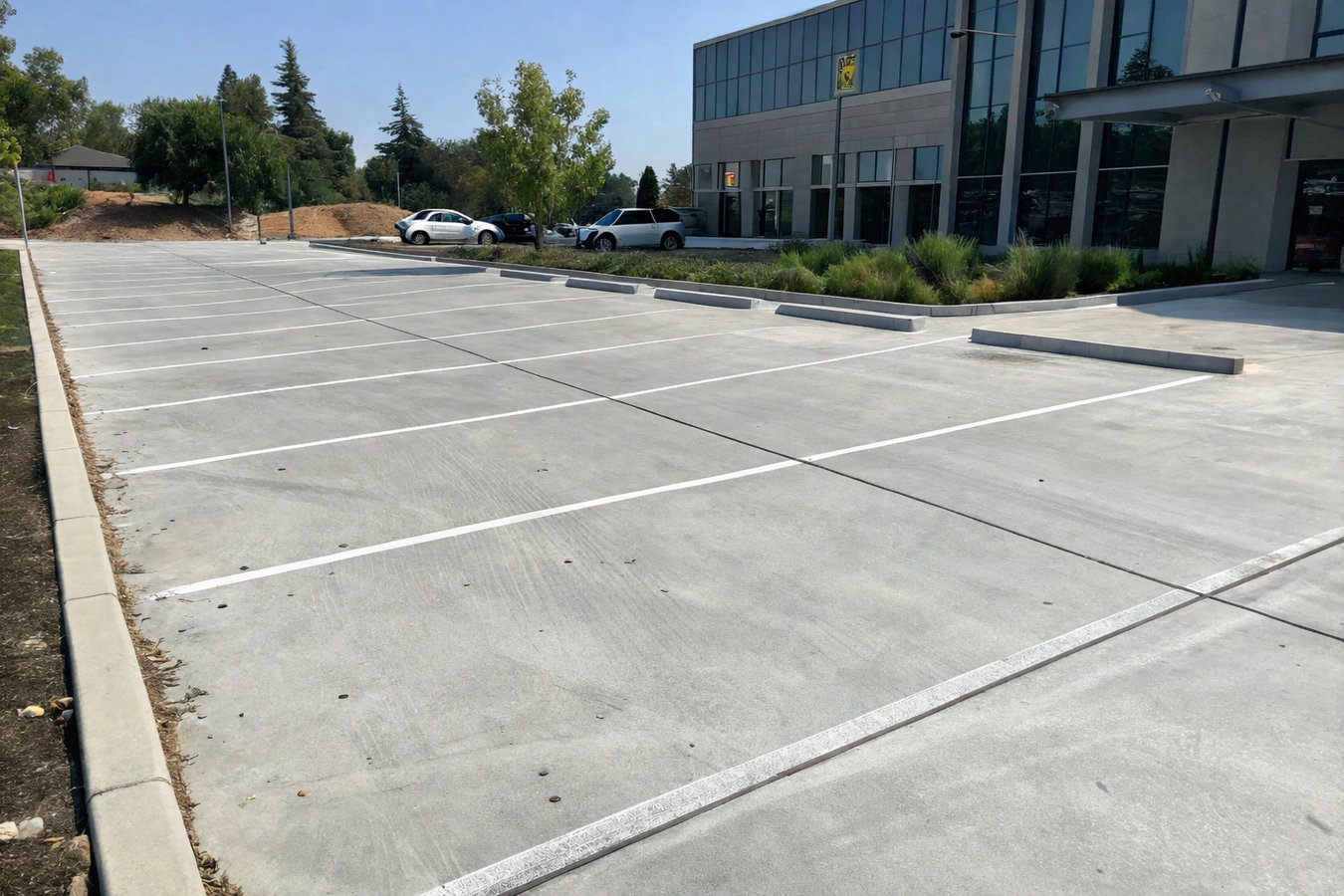
Your parking surface is failing - puddles, crumbling edges, uneven spots. We build it right from the base up so you get a solid, low-maintenance concrete lot that handles Florida's weather for decades.
Concrete parking lot building in Edgewater means excavating the existing surface, compacting Volusia County's sandy soil, laying a gravel base, and pouring a reinforced slab - most residential or small commercial lots take two to five days of active work, then 28 days of curing before regular vehicle use.
If your current surface is cracking, ponding water after every rainstorm, or simply made of gravel you are tired of dealing with, you are probably at the point where a concrete lot makes more long-term sense than another repair. Edgewater's sandy soil and heavy summer rains are tough on any parking surface, and how a lot is built - especially the base prep and drainage grading - determines whether it holds up for 30 years or starts cracking in five.
If your project includes shared driveway access, our concrete driveway building service covers residential driveway work that can be scoped and permitted alongside a lot project.
If puddles linger on your parking area for hours after rain - common in Edgewater's wet summers - the surface is no longer draining correctly. Standing water works into cracks and weakens the base beneath. A new concrete surface, properly graded for drainage, solves this at the source.
Small surface cracks are normal over time, but cracks wide enough to catch your finger, crumbling edges, or pieces breaking off entirely mean the surface has reached the end of its life. Patching buys a little time, but once a surface breaks apart in multiple spots, replacement is the more cost-effective long-term answer.
In Edgewater's sandy soil, the ground under a parking surface can shift after heavy rains or drought. If your lot has spots that feel higher or lower than they used to, or you feel a bump when you drive over it, the base has moved. An uneven surface is a trip hazard and a sign the foundation needs rebuilding.
If you are parking on gravel, packed dirt, or grass and are tired of the ruts and mud Florida's rainy season brings, that is a clear signal to invest in concrete. A properly built concrete lot gives you a clean, stable surface that holds up through decades of Florida summers without ongoing maintenance.
We handle every part of a concrete parking lot project - from pulling Volusia County permits to the final walkthrough. Our standard process includes removing the existing surface, excavating and compacting the subgrade, laying a gravel base layer, setting concrete forms, pouring reinforced concrete, finishing the surface, and cutting control joints at proper intervals to prevent random cracking. For properties near the Indian River Lagoon or in low-lying areas, we build drainage slope into the design from the start so water moves off the surface the way it should.
Most of our parking lot projects run alongside other work on the same property. If you need a concrete footings pour for a new structure nearby, or a concrete driveway that connects to the lot, we can scope and schedule both jobs together to save time and reduce disruption.
Best for property owners converting gravel, dirt, or grass to a permanent concrete surface.
Best for existing asphalt or concrete lots that have failed or are past their useful life.
Best for adding parking capacity to a current concrete or asphalt surface.
Best for flat or low-lying Edgewater properties where standing water is an ongoing problem.
Edgewater sits along the Indian River Lagoon in Volusia County, and that geography shapes everything about building a concrete parking lot here. The soil is predominantly sandy and loose, which means the subgrade compaction and gravel base steps are not optional extras - they are what separates a lot that lasts from one that starts cracking within a few years. Edgewater also receives roughly 50 to 55 inches of rain per year, most of it in intense summer storms. A lot that is not graded and sloped correctly from the start will pond water, and standing water is hard on concrete over time and creates a safety hazard for anyone using the surface.
Any new concrete surface in Edgewater may trigger a stormwater review under Volusia County's drainage rules, given the proximity to the lagoon. That means permits and inspections are part of the job, not an afterthought. We serve both the older residential neighborhoods east of US-1, including properties near the water in Edgewater, FL, and the communities immediately to the south in New Smyrna Beach, FL. Scheduling concrete work for late winter or early spring - before peak hurricane season - gives you the best combination of mild temperatures, lower rainfall, and a clear permit window.
We schedule a visit to measure the area, assess soil and drainage conditions, and discuss how you use the space. You receive a written estimate that covers excavation, base prep, materials, and finishing - no surprises after you sign.
We handle the Volusia County and City of Edgewater permit applications on your behalf. Permit processing typically takes a few days to a couple of weeks - factor this into your timeline, and plan for a permit window before the rainy season if scheduling matters.
On the first work day we remove the existing surface, excavate to the correct depth, compact the soil, and lay a gravel base. In Edgewater's sandy soil, this step takes more care than you might expect - it is what the pour's quality depends on.
We pour concrete early in the morning to beat Florida's afternoon heat, finish the surface, and cut control joints. Plan for the surface to be off-limits for at least seven days, and no vehicle traffic for 28 days. We walk through the finished project with you before we leave.
We visit your property, assess the soil and drainage, and give you a written quote - no obligation, no phone-only guesswork.
(386) 749-1231We have been doing concrete work in this area since 2019. We know the sandy soil conditions near the Indian River Lagoon, what Volusia County building inspectors look for, and how to plan drainage on flat coastal lots - knowledge you do not get from a crew driving in from another county.
We never quote over the phone without seeing the site. Your written estimate covers excavation, base preparation, materials, and finishing in full so you know exactly what you are paying before work begins - and the number does not change after you sign.
Volusia County requires permits for new impervious surfaces, and properties near the Indian River Lagoon may trigger a stormwater review. We manage all of it. The Florida Department of Business and Professional Regulation maintains a public license lookup at myfloridalicense.com where you can verify any contractor's credentials before hiring.
A concrete lot that ponds water is a problem that starts on day one and gets worse every season. We design drainage slope into every project upfront - not as an afterthought - so water moves off the surface the way it should through Edgewater's wet summers.
A concrete parking lot is a long-term investment, and the contractor you hire matters more than the price per square foot. Local experience, proper permits, and drainage built into the design from day one are what separate a surface that holds up for 30 years from one you are replacing in a decade. The Portland Cement Association outlines the construction standards that govern how a concrete lot should be designed and built for longevity.
Properly engineered footings anchor any structure you plan to build adjacent to or on the same property as your new parking surface.
Learn MoreA concrete driveway connection to your lot completes the approach - scoped and permitted as part of the same project to save time.
Learn MoreSpring is the best time to pour in Edgewater - get on our schedule now before the summer rains close in and contractor slots fill up.